
Conventional brokerage-custodied retirement accounts—such as standard IRAs and employer-sponsored 401(k) plans at institutions like Fidelity, Charles Schwab, or Vanguard—confine retirement capital to Wall Street products: publicly traded equities, mutual funds, exchange-traded funds (ETFs), and fixed-income bonds. While these platforms offer frictionless liquidity for traditional portfolios, they bar retirement savers from deploying capital into alternative, tangible, and high-yield private asset classes.
For sophisticated investors, family offices, and self-employed entrepreneurs, true portfolio resilience requires diversification into non-correlated assets: physical real estate, private mortgage lending, private debt funds, secured promissory notes, early-stage venture equity, and sovereign digital assets.
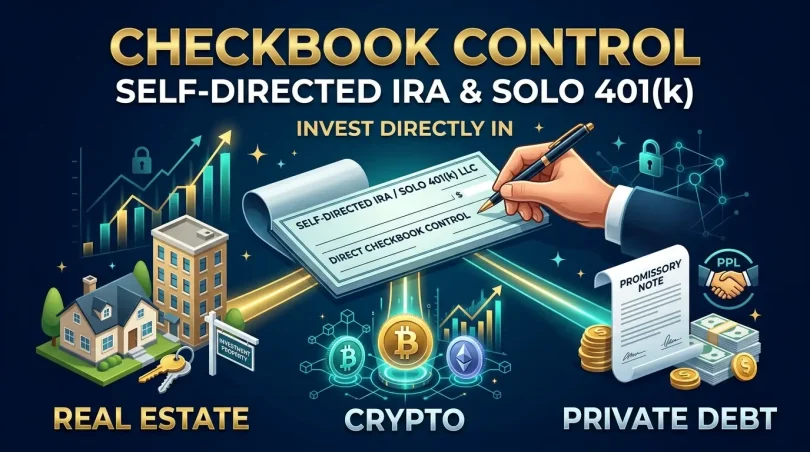
Accessing these markets through tax-sheltered accounts requires breaking away from conventional custodial restrictions. Checkbook Control—executed through either a Self-Directed IRA LLC (or Special-Purpose Trust) or an Owner-Only Solo 401(k)—gives the account owner direct transactional authority. Instead of waiting days or weeks for a third-party trust company to approve and process investment paperwork, the investor acts as the legal Manager or Trustee of the account’s underlying entity, executing investments in real time directly from a dedicated business checking account.
Achieving checkbook control requires operating within the strict framework of the Internal Revenue Code (IRC), federal tax jurisprudence, Department of Labor (DOL) regulations, and prohibited transaction statutes. Deviating from these rules can lead to substantial excise taxes, immediate plan disqualification, and catastrophic tax consequences.
1. Custodial Self-Directed IRAs vs. Checkbook Control Architecture
Before designing an alternative asset structure, investors must distinguish between basic Custodial Self-Directed IRAs and authentic Checkbook Control frameworks.
                          [ RETIREMENT AUTONOMY CONTINUUM ]
                                          │
    ┌─────────────────────────────────────┼─────────────────────────────────────┐
    ▼                                     ▼                                     ▼
Standard Brokerage IRA            Custodial SDIRA (Trust Co.)             Checkbook Control SDIRA / Solo 401(k)
• Stocks, bonds, mutual funds     • Real estate, private debt, notes    • Real-time capital deployment
• Wall Street product constraints • Every trade approved by custodian   • Zero per-transaction custodial fees
• Zero access to private deals    • Multi-day/week processing delays    • Direct check/wire authority via LLC or Trust
• Frictionless public liquidity   • Significant administrative fee drag • Complete fiduciary autonomy for investor
The Limitations of Custodial Self-Directed IRAs
Many non-bank trust companies market themselves as “Self-Directed IRA custodians.” While they permit investments in alternative assets, they operate under an administrative-approval model:
- Third-Party Paperwork Friction: Every earnest money deposit, earnest money release, contractor invoice, property tax installment, or private placement subscription requires submitting a formal Direction of Investment (DOI) form to the custodian.
- Processing Latency: Processing times range from 48 hours to more than two weeks. In competitive asset classes—such as real estate foreclosure auctions, time-sensitive private debt syndicates, or volatile cryptocurrency markets—this delay routinely causes deals to fall through.
- Transaction Fee Drag: Custodians often bill per transaction, charging fees for every outgoing wire, incoming rent check, asset re-titling, and document review. For an active private lender or real estate investor handling dozens of monthly payments, custodial fees quickly erode yields.
The Checkbook Control Solution
Checkbook control removes the custodian from daily investment activities:
- For the SDIRA: The custodian’s sole operational role is to hold 100% of the membership equity of a newly formed, specialized single-member Limited Liability Company (often referred to as an IRA/LLC). The account owner serves as the non-compensated Manager of the LLC. When the SDIRA purchases the LLC shares, the capital lands in a commercial business checking account. The Manager holds checkbook and wire access, buying assets and writing checks directly in the name of the LLC without seeking custodial sign-off.
- For the Solo 401(k): Autonomy is even greater. Because a Solo 401(k) is an ERISA-based qualified plan designed for owner-only businesses, no passive trust company custodian is legally required. The business owner acts as the designated Trustee of the 401(k) trust, opening a trust checking account directly at a commercial bank and executing transactions with complete checkbook authority.
2. Legal Foundations and Precedent: Swanson v. Commissioner
The legal framework supporting checkbook control is built on landmark Tax Court cases and administrative rulings from the Internal Revenue Service and Department of Labor.
                    [ STATUTORY FOUNDATION OF CHECKBOOK CONTROL ]

          Internal Revenue Code § 4975               Swanson v. Commissioner (1996)
         (Prohibited Transaction Rules)               (106 T.C. 76 - Landmark Precedent)
                      │                                               │
                      ▼                                               ▼
          Bars direct/indirect transactions           Tax Court ruled: Forming a brand-new
          between an IRA and a "Disqualified          entity capitalized by an IRA is NOT a
          Person" (e.g., self-dealing sales).         prohibited transaction under § 4975.
                                     │                                 │
                                     └────────────────┬────────────────┘
                                                      │
                                                      ▼
                                       Special-Purpose IRA/LLC Framework
                                      (Validated by IRS FSA 200128011)
The Benchmark Ruling: Swanson v. Commissioner (106 T.C. 76)
For decades, the IRS argued that an individual setting up an entity owned by their own IRA violated IRC § 4975, claiming the founder engaged in self-dealing with a disqualified person. This position was dismantled in the landmark case Swanson v. Commissioner (1996).
James Swanson established a newly incorporated entity (a domestic international sales corporation, or DISC) and directed his SDIRA custodian to purchase 100% of the newly issued original shares. Swanson appointed himself director and president. The IRS issued a notice of deficiency, arguing that because Swanson was an IRA fiduciary and a disqualified person, the sale of stock between the corporation and his IRA constituted a prohibited transaction under IRC § 4975(c)(1)(A).
The United States Tax Court ruled unequivocally against the IRS:
- A newly formed entity is not a disqualified person. At the exact moment of initial capitalization, the new entity has no prior operational history, no assets, and no disqualified relationships.
- Because the stock issued to the IRA was original issue stock, no transfer of property occurred between a disqualified person and the retirement plan.
- Serving as an officer or manager of the entity without receiving personal compensation does not violate prohibited transaction rules.
Affirmation: IRS Field Service Advice (FSA 200128011)
Following Swanson, the IRS issued Field Service Advice 200128011, confirming that an IRA owner can form a specialized single-member LLC, have the IRA acquire 100% of the membership interest, and serve as the manager without triggering a prohibited transaction.
Subsequent rulings, including Ellis v. Commissioner (T.C. Memo. 2013-245) and Peek v. Commissioner (140 T.C. 216), reinforced these boundaries: while the structural foundation of the IRA/LLC is entirely valid, executing personal loan guarantees or drawing personal compensation from the LLC will trigger disqualification.
3. Structural Comparison: SDIRA/LLC vs. The Solo 401(k)
Selecting the right vehicle depends on employment status, self-employment earnings, target asset classes, and borrowing needs.
                    [ VEHICLE SELECTION ARCHITECTURE ]

                                  Do you operate a business or earn
                                  self-employment income with ZERO
                                    full-time W-2 employees?
                                                │
                               ┌────────────────┴────────────────┐
                              YES                                NO
                               ▼                                 ▼
                     Solo 401(k) Plan                  Checkbook SDIRA / LLC
           • Maximum contribution: $69,000+       • Max contribution: $7,000 ($8,000 50+)
           • Complete exemption from UDFI on      • Subject to UDFI on leveraged real
             debt-financed real estate acquisition  estate purchases (IRC § 514)
           • Participant loans up to $50,000      • Loans to plan owner strictly barred
           • No custodial trust company required  • Passive custodian required for umbrella
| Structural Metric | Checkbook Self-Directed IRA LLC | Owner-Only Solo 401(k) |
| Eligibility Requirement | Any investor with existing IRA or rollovers; no business income needed | Requires self-employment or small business activity with no non-owner full-time employees |
| Custodian Requirement | Mandatory; passive trust company holds LLC shares | None required; plan owner serves as Plan Trustee |
| Annual Contribution Cap (2024/2026) | $7,000 ($8,000 if age 50+) | Up to $69,000 ($76,500+ with catch-ups via profit-sharing & elective deferrals) |
| Participant Loan Feature | Strictly Prohibited (Triggers immediate plan disqualification) | Permitted; borrow up to 50% of balance (max $50,000) for personal use |
| UDFI on Leveraged Real Estate | Fully Taxable under IRC § 514 on debt-financed portion | 100% Exempt from UDFI on real estate acquisition indebtedness under IRC § 514(c)(9) |
| Asset Protection | State-statute dependent for IRAs; varying homestead & debtor exemptions | Federal ERISA-equivalent protection in most jurisdictions; bankruptcy protection up to millions |
| Annual IRS Reporting | Custodian files Form 5498; owner files no annual form unless UBIT triggers | Owner files Form 5500-EZ annually once plan assets exceed $250,000 |
| Underlying Legal Structure | Custodian $\rightarrow$ Single-Member LLC $\rightarrow$ Business Checking Account | Plan Sponsor Company $\rightarrow$ Qualified Trust $\rightarrow$ Trust Checking Account |
4. The Prohibited Transactions Matrix (IRC § 4975)
Checkbook control grants direct transactional access to your account’s capital, which removes administrative safeguards. Operating an SDIRA or Solo 401(k) requires understanding the Prohibited Transaction rules under IRC § 4975.
                          [ THE DISQUALIFIED PERSON MAPPING ]

                 Lineal Ancestors (DISQUALIFIED)
                 • Parents, Grandparents, Great-Grandparents
                                │
                                ▼
  Permitted Collateral ◄─── THE INVESTOR ───► Permitted Collateral
  (PERMITTED COUNTERPARTS)    & SPOUSE        (PERMITTED COUNTERPARTS)
  • Brothers & Sisters                        • Aunts & Uncles
  • First Cousins                             • Nieces & Nephews
                                │
                                ▼
                 Lineal Descendants (DISQUALIFIED)
                 • Children, Grandchildren + Their Spouses
The Disqualified Person Framework (IRC § 4975(e)(2))
An SDIRA or Solo 401(k) cannot transact directly or indirectly with any Disqualified Person. This includes:
- The account holder and their legal spouse.
- Direct lineal ancestors: parents, grandparents.
- Direct lineal descendants: children, grandchildren, and their spouses (sons-in-law, daughters-in-law).
- Any plan fiduciary, custodian, or designated investment advisor.
- Any corporation, partnership, LLC, or trust in which a disqualified person owns or controls 50% or more of voting stock or beneficial interest.
- The Permitted Collateral Exception:Brothers, sisters, aunts, uncles, cousins, and unrelated business partners are NOT disqualified persons under federal statute. Your SDIRA can co-invest alongside or purchase properties from your sibling, assuming arms-length market pricing.
Prohibited Conduct Categories (IRC § 4975(c))
Violations are split into three operational categories:
[ Categorization of Prohibited Conduct ]
    ├── Direct Per Se Violations (IRC § 4975(c)(1)(A)–(C))
    │   • Selling, exchanging, or leasing property between plan and disqualified person.
    │   • Lending money or extending credit between plan and disqualified person.
    │   • Furnishing goods, services, or facilities between plan and disqualified person.
    │
    ├── Self-Dealing Violations (IRC § 4975(c)(1)(D)–(E))
    │   • Transferring plan income or assets to a disqualified person for personal benefit.
    │   • Fiduciary using plan assets for personal financial gain.
    │
    └── Kickback Violations (IRC § 4975(c)(1)(F))
        • Receiving personal consideration, fees, or commissions from a third party
          transacting with the retirement account.
The Sweating-Equity Violation: Ellis v. Commissioner
A frequent pitfall in self-directed real estate investing is providing personal physical labor (“sweat equity”) to an asset owned by your retirement account.
In Ellis v. Commissioner (T.C. Memo. 2013-245), the taxpayer used SDIRA funds to form an LLC that operated a used car business and drew an operational salary from the LLC. The Tax Court ruled that drawing compensation or providing uncompensated manual labor, property maintenance, construction, or active property management services to an IRA-owned asset constitutes furnishing services to the plan under IRC § 4975(c)(1)(C), instantly disqualifying the structure.
Operational Rule for Real Estate:
The plan owner cannot paint walls, fix plumbing, hang drywall, or act as an on-site property manager for real estate owned by their SDIRA LLC or Solo 401(k). All repairs, maintenance, and administrative operations must be handled by independent, third-party contractors paid directly from the retirement checking account at market rates.
The Catastrophic Penalty for SDIRA Disqualification
The tax code penalizes SDIRA and Solo 401(k) violations differently, making compliance critical:
- For the SDIRA: Under IRC § 408(e)(2), engaging in a single prohibited transaction—even an incidental one, such as using an LLC debit card to buy a $10 tank of gas for an investment property inspection—disqualifies the entire account retroactively to January 1st of that tax year. The fair market value of the entire IRA balance is treated as a fully taxable distribution, subject to ordinary income taxes, early distribution penalties (if under 59½), and accuracy-related penalties.
- For the Solo 401(k): Qualified plans operate under a different enforcement model. Violating § 4975 inside a 401(k) generally does not automatically disqualify the entire plan. Instead, the IRS levies an immediate 15% first-tier excise tax on the prohibited transaction’s dollar value, which scales to a 100% second-tier excise tax if the transaction is not corrected within the taxable period (using IRS Form 5330).
5. Alternative Asset Classes: Execution and Compliance Playbooks
Checkbook control allows you to deploy capital across alternative asset classes with the same speed as an institutional operating company.
                          [ ALTERNATIVE ASSET DEPLOYMENT CHANNELS ]
                                              │
    ┌─────────────────────────────────────────┼─────────────────────────────────────────┐
    ▼                                         ▼                                         ▼
Physical Real Estate Investments          Private Debt & Promissory Notes           Digital Assets & Cryptocurrencies
• Residential, commercial, raw land       • First-lien trust deeds & mortgages      • Cold storage hardware custody
• Non-recourse debt financing only        • Secured private business credit         • On-chain DeFi, staking, and yields
• Third-party property management         • Strictly barred from disqualified peers • Segregated institutional wallets
Asset Class A: Physical Real Estate (Direct Acquisition and Syndications)
Checkbook control turns your retirement vehicle into a private real estate operating fund.
- Entity Titling: All contracts, title deeds, insurance binders, and closing packages must be executed exclusively in the name of the entity:
$$\text{Incorrect Titling:} \quad \text{“John Doe” or “John Doe IRA”}$$$$\text{Correct Titling (SDIRA/LLC):} \quad \text{“Apex Equity Holdings LLC”}$$$$\text{Correct Titling (Solo 401k):} \quad \text{“Apex Retirement Trust, John Doe, Trustee”}$$ - Capital Flows: Earnest money deposits, purchase wires, and settlement costs must originate directly from the entity checking account. All rental payments, security deposits, and insurance claims must flow directly back into that account. Mixing personal capital with the entity’s funds triggers immediate account disqualification.
- The Non-Recourse Debt Mandate: An SDIRA or Solo 401(k) can use leverage to buy real estate, but the loan must be strictly non-recourse. Under IRC § 4975(c)(1)(B), an account owner cannot personally guarantee an obligation of their retirement plan:
- The lender’s sole collateral must be the physical property itself.
- The lender cannot seek deficiency judgments against the investor personal assets or the retirement account’s remaining balance.
- Peek v. Commissioner (140 T.C. 216) verified that an IRA owner signing a standard personal loan guarantee on a plan-owned transaction is an immediate, fatal prohibited transaction.
Asset Class B: Private Lending, Promissory Notes, and Private Credit
Retirement capital is well suited for generating passive, tax-sheltered fixed yields through private debt.
- Underwriting and Structuring: An SDIRA LLC or Solo 401(k) can originate secured or unsecured promissory notes, fund bridge loans, purchase second-lien paper, or buy syndicated private credit notes.
- Documentation Standards: The loan must be structured with institutional documentation:
- A formal Promissory Note defining loan principal, stated interest rate, amortization schedule, default interest, and maturity date.
- A recorded Deed of Trust or Mortgage securing the loan against identifiable real estate collateral, or a UCC-1 financing statement filed against business inventory or equipment.
- Usury Law Compliance: The interest rate must comply with state statutory usury ceilings.
- The Disqualified Borrower Rule: The borrower cannot be the investor, their spouse, parents, children, or a company in which they hold significant equity. Lending retirement capital to your son to buy a house, or to your own construction business to bridge cash flow, is a per se prohibited transaction under IRC § 4975(c)(1)(B).
Asset Class C: Digital Assets, Cryptocurrencies, and Self-Custody
Checkbook control provides an institutional approach to holding cryptocurrencies inside a retirement account, removing the counterparty risk of retail digital exchanges.
                  [ CRYPTOCURRENCY CHECKBOOK ARCHITECTURE ]

       ┌─────────────────────────────┐           ┌─────────────────────────────┐
       │   Corporate Entity Bank     │           │   Corporate Exchange Acct   │
       │   (Business Account in      │──────────►│  (Coinbase Prime, Kraken)   │
       │    Name of LLC or Trust)    │  USD Wire │  (Onboarded under Plan EIN) │
       └─────────────────────────────┘           └──────────────┬──────────────┘
                                                                │
                                                   Execute Spot │ Digital Asset Purchase
                                                                ▼
       ┌─────────────────────────────┐           ┌─────────────────────────────┐
       │  Institutional Multi-Sig /  │           │   Off-Exchange Withdrawal   │
       │  Dedicated Hardware Wallet  │◄──────────│  (Transfers out of exchange │
       │  (Stored in Vault Facility) │  Hardware │   counterparty risk pool)   │
       └─────────────────────────────┘  Transfer └─────────────────────────────┘
- Corporate Exchange Onboarding: The manager establishes a corporate trading account at an institutional digital asset exchange (e.g., Coinbase Prime, Kraken Institutional) opened strictly under the LLC or Trust’s legal name and EIN.
- Direct Wire Funding: Funds flow from the entity’s business bank account to the corporate exchange account via domestic wire. The trade executes directly on the platform.
- The Cold Storage Architecture and McNulty: After buying assets on an exchange, leaving tokens with the platform exposes capital to counterparty insolvency. Investors often transfer assets to private cold-storage hardware wallets (such as a Ledger or Trezor).
- Legal Realities Post-McNulty: In McNulty v. Commissioner (157 T.C. 10), the Tax Court ruled that holding physical IRA bullion in a home safe gave the taxpayer constructive receipt of the asset, triggering full distribution taxes.
- To insulate a crypto hardware wallet from constructive receipt challenges: The private seed phrases and physical hardware devices should not be kept in the investor’s personal residential possession. Best practice is to store the hardware wallet in a dedicated safe-deposit box chartered in the name of the LLC at a commercial bank, or place it in the custody of an institutional multi-signature storage provider (such as Unchained or Casa) where the entity retains keys under corporate governance.
6. Taxation Realities: UBTI, UDFI, and Form 990-T
While retirement accounts are generally tax-exempt under IRC § 408 and § 501, using alternative asset strategies can trigger Unrelated Business Income Tax (UBTI). Failing to understand UBTI is one of the most expensive mistakes an alternative asset investor can make.
                          [ UNRELATED BUSINESS TAXABLE INCOME (UBTI) ]
                                                │
       ┌────────────────────────────────────────┴────────────────────────────────────────┐
       ▼                                                                                 ▼
Active Business Operations (IRC § 512)                           Unrelated Debt-Financed Income (UDFI - IRC § 514)
• Holding an operating pass-through entity                       • Triggered when an asset is acquired using debt
  (e.g., restaurant LLC, hotel, operating SaaS)                  • Taxed proportionately to the average debt ratio
• Generating regular active trade/business income               • Solo 401(k) is 100% EXEMPT on real estate debt (§ 514(c)(9))
• Taxed at trust tax rates up to 37%                            • SDIRA LLC is FULLY TAXABLE on debt-financed portion
The Anatomy of Unrelated Business Taxable Income (UBTI)
Under IRC §§ 511–513, Congress created UBTI to prevent tax-exempt organizations and retirement funds from competing unfairly with tax-paying commercial businesses.
- Passive Income Exemption: By statute, true passive investment returns are completely exempt from UBTI. This safe harbor includes:
- Dividends and corporate distributions.
- Interest income on promissory notes and bonds.
- Royalties from intellectual property or mineral rights.
- Rental income from real property (residential and commercial leases).
- Capital gains realized from the sale, exchange, or disposition of investment assets.
- Active Trade or Business Exposure: If your SDIRA LLC or Solo 401(k) invests in a pass-through entity (such as a partnership or LLC) that conducts an active operating business—such as an operating manufacturing plant, an oil and gas working interest, a car wash, or a medical practice—the net operational income is classified as UBTI and taxed.
Unrelated Debt-Financed Income (UDFI)
Under IRC § 514, when a retirement account buys an asset using leverage (debt financing), that asset becomes debt-financed property. The income derived from that asset is partially classified as Unrelated Debt-Financed Income (UDFI), an offshoot of UBTI.
- The Debt-to-Basis Formula: The portion of income subject to UDFI is directly proportional to the asset’s debt ratio:
$$\text{Debt-Financed Percentage} = \frac{\text{Average Acquisition Indebtedness}}{\text{Average Adjusted Basis of Property}}$$
$$\text{Taxable UDFI} = \text{Net Income (or Capital Gain)} \times \text{Debt-Financed Percentage}$$
Illustrative Example of SDIRA UDFI Calculation:
An SDIRA LLC purchases a commercial real estate property for $1,000,000:
- The SDIRA provides $400,000 cash as a down payment.
- A non-recourse lender provides a $600,000 loan (60% leverage).
- The property generates $100,000 in net rental income in year one (after allowable operational deductions and depreciation):
$$\text{Taxable UDFI Portion} = \$100,000 \times 60\% = \$60,000$$
That $60,000 of income is subject to UBTI tax, while the remaining $40,000 flows into the SDIRA completely tax-free.
The Critical Solo 401(k) Advantage: IRC § 514(c)(9) Exemption
For real estate investors who use leverage, the Solo 401(k) offers a decisive statutory advantage over the SDIRA.
Under IRC § 514(c)(9), Congress granted qualified pension, profit-sharing, and stock-bonus plans under IRC § 401 an explicit statutory exemption from UDFI on acquisition indebtedness incurred to buy real property.
- IRAs are explicitly excluded from the § 514(c)(9) safe harbor. An SDIRA buying real estate with a non-recourse loan will owe UDFI annually on both rental income and final capital gains upon sale.
- A Solo 401(k) is 100% exempt from UDFI on real estate acquisition debt. A Solo 401(k) can fund a property purchase with 75% non-recourse debt, collect the net rents, sell the asset for a multimillion-dollar capital gain, and pay zero federal income tax on the gains.
Filing IRS Form 990-T and Trust Tax Brackets
When an SDIRA or Solo 401(k) earns more than $1,000 of gross UBTI/UDFI in a tax year:
- The retirement account must obtain its own independent tax ID and file IRS Form 990-T (Exempt Organization Business Income Tax Return).
- Who Pays the Tax: The tax must be paid directly from the retirement account or LLC balance. The account owner cannot pay this tax using outside personal funds; doing so constitutes an unauthorized plan contribution.
- The Tax Rate: UBTI inside an IRA is taxed at Trust and Estate income tax rates, which hit the highest federal tax bracket (37%) at low income thresholds (typically above ~$15,000 of taxable earnings).
7. Step-by-Step Formation and Operating Blueprint
Setting up a checkbook control vehicle requires coordinated legal, administrative, and banking steps.
[ Phase 1: Eligibility Screening & Plan Selection ]
      │
      ▼
[ Phase 2: Entity Formation & Operating Agreement ]
      │
      ▼
[ Phase 3: EIN Registration & Banking Footprint ]
      │
      ▼
[ Phase 4: Custodial Capital Transfer & Funding ]
      │
      ▼
[ Phase 5: Investment Execution & Recordkeeping ]
      │
      ▼
[ Phase 6: Annual IRS Compliance & Filings ]
Phase 1: Eligibility Screening and Vehicle Selection
- Assess Self-Employment Footprint: Determine if you have active, verified sole proprietorship, single-member LLC, or S-Corp income derived from 1099 consulting, freelancing, or small business operations without non-owner full-time employees (who work over 1,000 hours annually).
- Select the Structure: If self-employed, choose the Solo 401(k) to secure higher contribution limits, loan provisions, and the § 514(c)(9) UDFI real estate exemption. If rolling over capital without self-employment income, choose the Checkbook SDIRA/LLC.
Phase 2: Entity Formation and Specialized Operating Agreements
- Form the Special-Purpose Entity: For an SDIRA, file Articles of Organization in a business-friendly jurisdiction (such as Wyoming, Delaware, or your home state) for a dedicated LLC.
- Draft a Customized Retirement Operating Agreement: Standard, off-the-shelf LLC operating agreements are insufficient. The operating agreement must contain specialized statutory provisions:
- Explicitly restrict membership to the designated SDIRA Custodian FBO [Your Name] IRA.
- Ban any distributions or loans directly to disqualified persons.
- Cap the Manager’s authority strictly to actions permissible under IRC § 4975.
- State that the LLC is formed solely to facilitate investments for its retirement plan owner.
Phase 3: Federal Tax ID (EIN) and Business Banking
- Obtain an Entity EIN: Apply for a dedicated Employer Identification Number via IRS Form SS-4.
- SDIRA LLC: The LLC is structured for tax purposes as a Single-Member Disregarded Entity owned by the custodian trust company.
- Solo 401(k): The EIN must be applied for strictly in the name of the Retirement Trust, checking the box for “Plan Administrator / Trust,” never as a sole proprietorship.
- Establish a Corporate Checking Account: Open a dedicated commercial business checking account at a bank that understands retirement plan structures. Provide the filed Articles, customized Operating Agreement/Plan Document, and the IRS EIN confirmation letter.
Phase 4: Capital Transfer and LLC Capitalization
- Custodian-to-Custodian Transfer: Initiate a direct rollover or trustee-to-trustee transfer of liquid funds from your current custodian (Schwab, Fidelity, etc.) to your designated SDIRA custodian.
- Direction of Investment Execution: Once cash arrives, submit a Direction of Investment (DOI) instructing the custodian to purchase 100% of the membership units of your newly formed LLC for the exact cash balance.
- Capital Wire: The custodian wires the funds directly into your new LLC checking account. Checkbook control is now active.
Phase 5: Investment Execution and Asset Titling
- Execute the Investment: Write a check or send a wire directly from the entity account to title companies, escrow agents, note borrowers, or corporate cryptocurrency exchanges.
- Title the Asset Correctly: Ensure all real estate deeds, notes, subscription agreements, and assignments are titled directly in the name of the LLC or the 401(k) Trust.
Phase 6: Ongoing Compliance and Annual Reporting
- Annual Fair Market Value (FMV) Updates: For the SDIRA LLC, supply the passive custodian with an annual Fair Market Valuation of the LLC’s underlying assets by December 31st, so they can report account values accurately on IRS Form 5498.
- IRS Form 5500-EZ Administration: For a Solo 401(k), once total plan assets (cash and investments combined) exceed $250,000 at the close of the plan year, the plan administrator must file an annual Form 5500-EZ with the IRS.
- Form 990-T Reporting: If the vehicle earns more than $1,000 in gross UBTI or UDFI during the year, complete and file Form 990-T and remit taxes directly from the retirement checking account.
8. Operational Traps, Audit Triggers, and Defensive Protocols
Operating with checkbook control requires disciplined administration. The IRS monitors self-directed structures closely for transactions that trigger personal benefit or commingling.
[ Primary Regulatory & Audit Vulnerabilities ]
    ├── Direct Commingling: Depositing personal funds into the retirement checking account.
    ├── Personal Credit Usage: Using personal credit scores or guarantees to secure plan financing.
    ├── Prohibited Asset Classes: Purchasing art, antiques, gems, or alcoholic beverages (IRC § 408(m)).
    ├── Expense Leakage: Paying personal home office expenses, mileage, or meals from plan cash.
    └── Early Entity Formation Errors: Transferring an asset you already personally own into the plan.
1. Commingling Personal and Retirement Capital
A retirement account is an independent legal and tax entity. You cannot temporarily move personal cash into your SDIRA LLC account to cover an unexpected property repair, nor can you sweep excess real estate rent into your personal account to cover household expenses. Every dollar entering or leaving the entity must trace directly to a verified retirement transaction.
2. The Personal Asset Transfer Trap
Under IRC § 4975(c)(1)(A), selling or transferring property between a retirement plan and a disqualified person is strictly prohibited:
- You cannot sell real estate, notes, or business equity that you personally own into your SDIRA or Solo 401(k).
- You cannot transfer an existing family home or personal vacation property into the plan.
- Every asset purchased by the entity must be acquired from an unrelated third party in an arms-length transaction.
3. Prohibited Asset Classes Under IRC § 408(m)
While checkbook control unlocks alternative investments, specific asset classes remain restricted by federal statute:
- Artwork, Rugs, and Antiques: Banned under collectibles rules.
- Gems and Stamps: Prohibited.
- Alcoholic Beverages (e.g., Fine Wine/Whiskey casks): Strictly barred.
- Life Insurance Contracts: Prohibited within IRAs (though strictly regulated exceptions exist inside certain qualified 401(k) plans under the “incidental benefit” rule).
4. Personal Use and Vacation Home Violations
You cannot purchase a residential or vacation property through your retirement entity and stay in it—even for a single night.
Allowing yourself, your spouse, your parents, or your children to use a plan-owned property for personal recreation constitutes an immediate prohibited transaction under IRC § 4975(c)(1)(D) (transfer to, or use by, a disqualified person of the income or assets of a plan).
The property must operate entirely as a commercial, third-party investment asset, leased to unrelated tenants at prevailing fair-market rents.
Strategic Action Checklist for Deploying Checkbook Control
- Assess Self-Employment Status: Confirm whether you have active business or self-employment earnings to determine if you qualify for a Solo 401(k) or need a Checkbook SDIRA/LLC.
- Evaluate Real Estate Leverage Needs: If using debt financing to buy real estate, prioritize a Solo 401(k) to secure the IRC § 514(c)(9) exemption from Unrelated Debt-Financed Income (UDFI).
- Form a Dedicated Legal Entity: Work with experienced legal counsel to form a specialized LLC or Qualified Trust using operating documents designed specifically for retirement plan ownership.
- Partner with a Specialized Non-Bank Custodian: For an SDIRA, use a passive trust company that charges a low flat annual fee rather than an asset-based percentage fee.
- Set Up Commercial Business Checking: Establish a dedicated business checking account in the entity’s legal name, ensuring you have check and wire authority.
- Verify Non-Recourse Loan Terms: If using financing, make sure the lender issues a verified non-recourse promissory note and mortgage with zero personal guarantees.
- Isolate Management Operations: Hire independent, third-party contractors and property managers to perform all physical labor, maintenance, and day-to-day operations.
- Monitor Annual IRS Reporting Thresholds: Track the $250,000 balance threshold for filing Solo 401(k) Form 5500-EZ, keep Fair Market Valuations current for Form 5498, and file Form 990-T if gross UBTI exceeds $1,000.