
In the wake of regional banking stress, sudden liquidity freezes, and high-profile institutional bank runs, corporate treasury departments, family offices, and ultra-high-net-worth individuals (UHNWIs) face a fundamental liquidity management dilemma: the systemic danger of holding concentrated, uninsured cash deposits.
For decades, mid-sized enterprises, venture-backed startups, municipal governments, and wealthy families routinely parked tens of millions of dollars in single commercial banking institutions. Cash management was treated as a low-touch operational task. However, fractional-reserve banking realities mean that deposits exceeding statutory insurance caps transform the depositor from an ordinary customer into an unsecured general creditor of the financial institution.
When an institution suffers sudden asset-liability duration mismatches or panic-driven liquidity extraction, uninsured balances are exposed to immediate insolvency haircuts, receivership freezes, and protracted regulatory resolution.
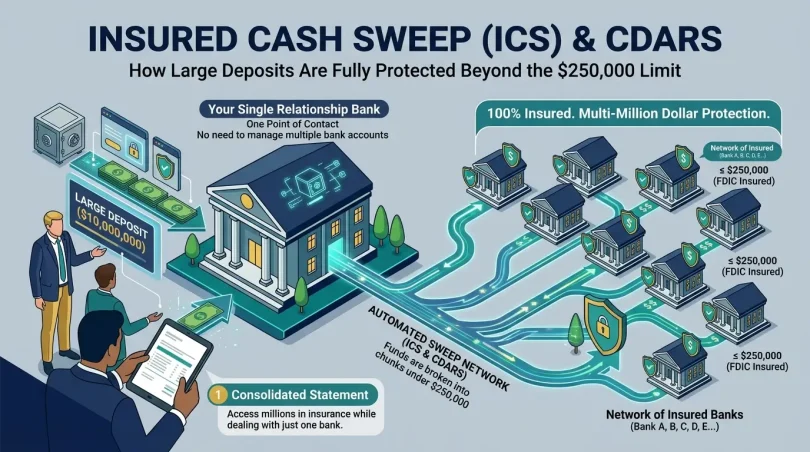
To neutralize this counterparty exposure without multiplying operational overhead across hundreds of discrete banking relationships, institutional treasuries deploy IntraFi Network Deposits—specifically the Insured Cash Sweep (ICS) and the Certificate of Deposit Account Registry Service (CDARS).
These interbank reciprocal deposit engines allow corporate depositors and wealthy individuals to access multi-million-dollar (and in some cases nine-figure) government-backed deposit insurance coverage through a single primary banking relationship. This guide provides a comprehensive analysis of the statutory frameworks, clearing mechanics, balance sheet treatments, yield dynamics, and operational governance required to deploy ICS and CDARS structures at scale.
1. The Anatomy of Uninsured Cash and Systemic Counterparty Risk
To understand the institutional necessity of reciprocal deposit architectures, one must first quantify the legal and economic mechanics of standard commercial bank deposits.
                          [ THE CONVENTIONAL CASH STORAGE VULNERABILITY ]

               $20,000,000 Corporate Cash Deposited in a Single Commercial Bank
                                                │
       ┌────────────────────────────────────────┴────────────────────────────────────────┐
       ▼                                                                                 ▼
Statutory Insured Slice: $250,000 (1.25%)                         Uninsured Exposure: $19,750,000 (98.75%)
• Backed by full faith & credit of sovereign government           • Classified as an Unsecured General Debt of the bank
• Absolute, guaranteed recovery upon FDIC receivership            • Absorbs first-dollar balance sheet insolvency losses
• Frictionless liquidity restored within 24–48 hours              • Dependent on bankruptcy asset sales and receivership dividends
The Legal Status of Bank Deposits
When a company or individual deposits money into a commercial checking, savings, or money market account, the bank does not hold those physical funds in a dedicated vault as a bailee. Legally, the transaction is an unsecured loan made by the depositor to the bank. The cash becomes an asset of the bank, and the depositor receives an uncollateralized liability (an accounting promise to repay on demand).
Under a fractional-reserve regime, banks leverage these deposits into illiquid commercial real estate mortgages, long-duration fixed-rate sovereign securities, and commercial loans. If a liquidity mismatch occurs and depositors demand their capital faster than the bank can liquidate its balance sheet, the bank faces insolvency.
The Limits of FDIC Ownership Categories
The Federal Deposit Insurance Corporation (FDIC) in the United States—like the Financial Services Compensation Scheme (FSCS) in the UK and Deposit Guarantee Schemes (DGS) across the European Union—insures deposits up to a fixed statutory limit: $250,000 per depositor, per insured depository institution (IDI), for each account ownership category.
The FDIC recognizes several distinct legal ownership capacities:
- Single accounts (held by an individual).
- Joint accounts ($250,000 per co-owner, max $500,000 for two owners).
- Revocable trust accounts (insured up to $250,000 per primary beneficiary, capped at five beneficiaries or $1,250,000).
- Corporations, partnerships, and unincorporated associations.
Crucially for commercial enterprises and institutional allocators, all accounts held by a single corporation, LLC, or partnership within the same banking institution are pooled and treated as a single ownership entity.
If a corporation maintains:
- An operating payroll account with $2,000,000,
- A tax reserve account with $1,500,000, and
- A liquidity sweep account with $15,000,000,
The entire $18,500,000 aggregate balance is covered up to a single $250,000 limit. The remaining $18,250,000 represents pure, uncollateralized credit risk to that single corporate balance sheet.
2. The Genesis of Reciprocal Deposits: The IntraFi Network Architecture
Historically, if an institutional treasurer wished to protect a $25 million cash balance using sovereign insurance, the operational logistics were complex:
[ Traditional Manual Multi-Bank De-Risking (Historical Friction) ]
    ├── Treasury opens and documents 100 discrete commercial bank relationships.
    ├── Legal and compliance teams negotiate 100 Master Services Agreements and KYC files.
    ├── Accounting team reconciles 100 distinct monthly bank statements.
    ├── Finance team tracks 100 distinct online banking logins and wire portals.
    └── Year-end audit requires collecting and auditing 100 individual IRS Forms 1099-INT.
This structural friction led to the formation of the Promontory Interfinancial Group (rebranded as IntraFi Network), founded by former federal banking regulators and senior financial executives. IntraFi engineered an automated interbank routing and clearing architecture that transforms thousands of independent financial institutions into a cohesive reciprocal network.
                    [ THE INTRAFI RECIPROCAL CLEARING MATRIX ]

                               ┌─────────────────────────────┐
                               │     Corporate Depositor     │
                               │   (Deposits $10,000,000)    │
                               └──────────────┬──────────────┘
                                              │ Single Banking Relationship
                                              ▼
                               ┌─────────────────────────────┐
                               │     Relationship Bank       │
                               │  (Primary Commercial Bank)  │
                               └──────────────┬──────────────┘
                                              │
                         Breaks balance into  │ Routes through automated
                         chunks under $250k   │ IntraFi interbank clearinghouse
                                              ▼
┌────────────────────────────────────────────────────────────────────────────────────────┐
│                        INTRAFI RECIPROCAL SETTLEMENT PLATFORM                          │
└──────┬──────────────────────┬──────────────────────┬──────────────────────┬────────────┘
       │                      │                      │                      │
       ▼                      ▼                      ▼                      ▼
┌──────────────┐       ┌──────────────┐       ┌──────────────┐       ┌──────────────┐
│  Bank A      │       │  Bank B      │       │  Bank C      │       │  Bank D–N    │
│  Deposit:    │       │  Deposit:    │       │  Deposit:    │       │  Deposits:   │
│  $245,000    │       │  $245,000    │       │  $245,000    │       │  $245,000 ea │
│  (100% FDIC) │       │  (100% FDIC) │       │  (100% FDIC) │       │  (100% FDIC) │
└──────────────┘       └──────────────┘       └──────────────┘       └──────────────┘
       ▲                      ▲                      ▲                      ▲
       └──────────────────────┴──────────────┬───────┴──────────────────────┘
                                             │
                   Reciprocal Balance Inflow │ Relationship bank receives identical
                   Maintains Balance Sheet   │ deposits from network members,
                   Liquidity Neutrality      │ preserving its deposit base.
The Core Premise of Reciprocal Deposits
The IntraFi network includes thousands of commercial banks and savings institutions across the United States.
The system operates on an automated reciprocal mechanism:
- Placement: The depositor deposits a large sum (e.g., $10 million) with their chosen local or regional Relationship Bank.
- Fractional Dispersal: The Relationship Bank, using IntraFi’s programmatic clearing software, breaks the multi-million-dollar deposit into parcels below the statutory threshold (typically $245,000 to $248,000, leaving an intentional buffer for accrued interest).
- Network Allocation: These sub-$250,000 tranches are routed across dozens or hundreds of independent, vetted network member banks.
- Automatic Coverage: Because no individual institution holds more than $248,000 for that depositor, every single dollar across the entire $10 million balance is 100% covered by FDIC insurance.
- Reciprocal Balance Preservation: Crucially for the Relationship Bank, the transaction is reciprocal. For every dollar the Relationship Bank exports into the network, it receives an equivalent dollar of deposits originating from other network banks. As a result, the Relationship Bank’s total balance sheet deposits and lending capacity remain completely neutral.
3. Product Deep Dive: Insured Cash Sweep (ICS)
The Insured Cash Sweep (ICS) is IntraFi’s daily liquid cash management product. It is designed for operational capital, payroll reserves, dynamic working capital, and balances that require ongoing accessibility.
                              [ THE DUAL-MODALITY ICS ENGINE ]

               Demand Deposit Option (DDA)                       Money Market Deposit Option (MMDA)
┌────────────────────────────────────────────────────────┐ ┌────────────────────────────────────────────────────────┐
│ • Built for active daily operational spending.         │ │ • Built for high-yield, short-term liquidity reserves. │
│ • Unlimited daily deposits and withdrawals.            │ │ • Higher baseline interest yield (APY).                │
│ • Seamlessly funds daily corporate operating checking. │ │ • Unlimited daily automated internal sweeps.           │
│ • Direct linkage to automated ERP treasury systems.    │ │ • Optimal balance between yield and risk-free custody. │
└────────────────────────────────────────────────────────┘ └────────────────────────────────────────────────────────┘
Modality 1: The Demand Deposit Option (DDA)
The Demand Deposit Option connects directly to an active corporate checking account:
- Operational Mechanism: Funds deposited into an ICS Demand account can be accessed continuously.
- Transaction Limits: There are zero statutory limits on the frequency of withdrawals or transfers.
- Target Capital: Ideal for primary operational working capital, recurring supplier disbursements, and bi-weekly payroll funding accounts where daily liquidity is a non-negotiable requirement.
Modality 2: The Money Market Deposit Option (MMDA)
The Money Market Deposit Option functions as an interest-bearing liquidity reserve:
- Yield Generation: Operates as a savings vehicle, providing an institutional interest yield on the swept capital.
- The Regulatory Shift (Federal Reserve Regulation D Amendment): Historically, Federal Reserve Regulation D placed a strict ceiling of six convenience withdrawals per calendar month on MMDA accounts. In April 2020, the Federal Reserve Board issued an interim final rule amending Regulation D, deleting the six-transfer limit. Today, IntraFi MMDA setups permit high-frequency sweep connectivity, allowing treasurers to maximize yield without arbitrary monthly transfer restrictions.
Intra-Day and Daily Clearing Protocols
The operational mechanics of an ICS account follow a strict, automated daily clearing cycle:
[ 09:00 AM - 02:00 PM EST: Daily Operational Window ]
    Corporate treasurer receives receivables, routes domestic ACHs, executes vendor wires.
    Operating checking account fluctuates dynamically throughout the business day.
                          │
                          ▼
[ 03:00 PM - 04:00 PM EST: Ledger Sweep Calculation ]
    The Relationship Bank runs its end-of-day automated cash management batch.
    Operating account balances above the set peg (e.g., $100,000 target balance)
    are identified as excess investable cash.
                          │
                          ▼
[ 05:00 PM - 08:00 PM EST: IntraFi Network Clearing & Settlement ]
    IntraFi’s routing engine calculates net network inflows and outflows.
    Surplus funds are fragmented into sub-$248k parcels and wired via Fedwire
    to designated destination banks.
                          │
                          ▼
[ 08:30 PM EST: Daily Confirmation Reconciliation ]
    A comprehensive, automated clearing confirmation is generated.
    The depositor’s consolidated ledger updates, confirming that 100% of the swept
    balance rests safely under FDIC insurance across the network.
If the corporate operating checking account runs a deficit the following morning due to outgoing wires or vendor checks presented for settlement, the system automatically triggers a reverse sweep, pulling funds back from the IntraFi network into the local checking account to satisfy all liabilities seamlessly.
4. Product Deep Dive: Certificate of Deposit Account Registry Service (CDARS)
While ICS addresses daily, dynamic operational liquidity, CDARS (Certificate of Deposit Account Registry Service) is IntraFi’s fixed-term, yield-optimized cash preservation product.
                         [ CDARS INSTITUTIONAL TERM ENGINE ]

                     POOLED CASH ALLOCATION (e.g., $15,000,000)
                                          │
    ┌──────────────────┬──────────────────┼──────────────────┬──────────────────┐
    ▼ (4-Week CD)      ▼ (13-Week CD)     ▼ (26-Week CD)     ▼ (52-Week CD)     ▼ (3-Year CD)
$3,000,000 Bucket  $3,000,000 Bucket  $3,000,000 Bucket  $3,000,000 Bucket  $3,000,000 Bucket
• 12+ Network      • 12+ Network      • 12+ Network      • 12+ Network      • 12+ Network
  Banks ($245k ea)   Banks ($245k ea)   Banks ($245k ea)   Banks ($245k ea)   Banks ($245k ea)
• 100% FDIC        • 100% FDIC        • 100% FDIC        • 100% FDIC        • 100% FDIC
• Matures Month 1  • Matures Month 3  • Matures Month 6  • Matures Month 12 • Matures Month 36
The Structural Mechanics of CDARS
CDARS functions on the same core reciprocal platform as ICS, but deploys cash into Certificates of Deposit (CDs) rather than liquid demand accounts:
- Maturity Tenors Available: CDARS provides access to standard institutional maturity tiers: 4 weeks, 13 weeks, 26 weeks, 52 weeks, 2 years, 3 years, and 5 years.
- Fixed APY Assurance: When an investor places funds into CDARS, they lock in an agreed Annual Percentage Yield (APY) negotiated directly with the Relationship Bank for the entire maturity duration.
- Underlying CD Documentation: The depositor does not sign separate deposit agreements with dozens of individual banks. The placement is governed by a single overarching CDARS Master Placement Agreement, while the underlying institutions issue electronic, book-entry certificates of deposit registered in the custodial name of IntraFi’s settlement agent for the beneficial interest of the depositor.
Constructing an Institutional CDARS Ladder
To balance higher yields with recurring liquidity, corporate treasurers and family offices deploy CDARS Maturity Ladders:
[ Quarterly Institutional CDARS Ladder Structure ]
    Total Allocated Reserve: $20,000,000
    ├── Tranche 1 ($5,000,000) : 3-Month CDARS Tenor (Matures in 90 Days)
    ├── Tranche 2 ($5,000,000) : 6-Month CDARS Tenor (Matures in 180 Days)
    ├── Tranche 3 ($5,000,000) : 9-Month CDARS Tenor (Matures in 270 Days)
    └── Tranche 4 ($5,000,000) : 12-Month CDARS Tenor (Matures in 360 Days)
The Strategic Mechanics: Every 90 days, a $5,000,000 tranche matures with full accrued interest. The treasurer evaluates current working capital needs:
- If liquidity is needed for tax obligations, strategic investments, or CapEx, the $5,000,000 sweeps seamlessly into the operating account.
- If cash reserves remain surplus, the tranche is rolled over into a new 12-month CDARS term, maintaining an ongoing pipeline of continuous liquidity and high fixed yields, with zero uninsured counterparty exposure.
5. Reciprocal Deposits vs. One-Way Buy/Sell Placements
A critical operational distinction within the IntraFi network lies in the structural difference between Reciprocal Deposits and One-Way Placements.
                          [ TRANSACTIONAL ROUTING TAXONOMY ]
                                           │
    ┌──────────────────────────────────────┴──────────────────────────────────────┐
    ▼                                                                             ▼
Reciprocal Deposit Placement                                              One-Way Buy / Sell Placement
• Relationship Bank sends $10M out; receives $10M in                      • Relationship Bank places excess liquidity without taking matching cash
• 100% Balance-Sheet Neutral for Relationship Bank                        • Used when a bank has too much liquidity or needs quick funding
• Preserves local lending capacity and community credit                   • Pricing and yields decoupled from local Relationship Bank spreads
• Preferred regulatory status under US Senate Bill 2155                   • Subject to wholesale funding rules and regulatory classifications
Reciprocal Placements: Balance-Sheet Neutrality
Under the standard reciprocal model:
- When a client deposits $20 million into a regional bank and elects to sweep it via ICS, the bank exports that capital to member institutions across the network.
- Concurrently, IntraFi’s centralized ledger routes $20 million of reciprocal, fragmented deposits originating from other network institutions directly back onto the regional bank’s balance sheet.
- Why Banks Prefer Reciprocal Deposits: The regional bank maintains its total Assets Under Administration (AUA) and net deposit base. It continues utilizing those reciprocal deposits to underwrite commercial mortgages, middle-market business loans, and regional infrastructure projects. The bank maintains its net interest margin (NIM) and pays the client an attractive yield while avoiding balance-sheet contraction.
One-Way Placements (Buy vs. Sell)
Occasionally, a bank’s internal asset-liability committee (ALCO) faces imbalance:
- One-Way Sell (Excess Liquidity): A bank has more deposits than it can profitably deploy into quality loans. In this scenario, the bank uses IntraFi to sweep the depositor’s cash out into network banks without requesting reciprocal deposits in return. The depositor receives full FDIC coverage, and the bank earns a placement fee without bloating its balance sheet.
- One-Way Buy (Wholesale Funding): A bank needs deposits to fund expanding loan pipelines. The bank can act as an inbound recipient of IntraFi deposits, purchasing insured funds directly from the network to satisfy liquidity ratios without issuing brokered CDs on Wall Street.
6. The Legislative Turning Point: S. 2155 and Regulatory Modernization
Historically, conservative corporate treasurers were hesitant to use sweep platforms due to regulatory classifications that labeled reciprocal deposits as “Brokered Deposits.”
                       [ STATUTORY EVOLUTION OF RECIPROCAL DEPOSITS ]

   PRE-2018: FDIA Section 29 Restrictions                   POST-2018: S. 2155 Regulatory Carve-Out
┌───────────────────────────────────────────────┐ ┌───────────────────────────────────────────────┐
│ • ALL reciprocal network deposits classified  │ │ • Reciprocal deposits EXEMPTED from brokered  │
│   as "Brokered Deposits" by the FDIC.         │ │   deposit classification under clear limits.  │
│ • Viewed as unstable "hot money."             │ │ • Treated legally as core, stable deposits.   │
│ • Banks penalized with higher insurance       │ │ • Banks avoid insurance assessment surcharges.│
│   assessments and capital requirements.       │ │ • Expanded adoption across major institutions.│
└───────────────────────────────────────────────┘ └───────────────────────────────────────────────┘
The Historic “Brokered Deposit” Stigma
Under Section 29 of the Federal Deposit Insurance Act (FDIA), the FDIC historically defined brokered deposits as funds obtained, directly or indirectly, through a deposit broker. Regulators viewed brokered deposits with skepticism, treating them as volatile, yield-seeking “hot money” that could vanish at the first sign of bank distress.
Consequently, banks that accepted reciprocal deposits were subjected to higher FDIC assessment rates, strict regulatory caps, and limitations on their ability to use those deposits if their regulatory capitalization levels dropped.
The Legislative Fix: Economic Growth, Regulatory Relief, and Consumer Protection Act
In May 2018, the US Congress enacted the Economic Growth, Regulatory Relief, and Consumer Protection Act (Public Law 115-174, Section 202), commonly known as S. 2155.
This legislation amended the Federal Deposit Insurance Act to explicitly carve out reciprocal deposits:
- Statutory Exemption: Reciprocal deposits are no longer classified as brokered deposits, provided the receiving institution meets specific criteria:
- The bank is “well-capitalized” and holds a composite CAMELS rating of 1 or 2.
- Total reciprocal deposits do not exceed the lesser of $5 billion or 20% of the institution’s total liabilities.
- Core Deposit Classification: Reciprocal deposits matching these safe harbors are legally treated as core deposits. They are recognized as stable, sticky, relationship-driven capital.
- Result for Depositors: S. 2155 eliminated the regulatory friction that previously discouraged banks from offering ICS and CDARS. As a result, nearly every major community, regional, and national commercial bank has integrated reciprocal deposit rails into its cash management suite.
7. Comparative Analysis: ICS/CDARS vs. T-Bills vs. MMFs vs. Repo
Institutional treasurers managing significant cash reserves do not rely on a single instrument. They structure portfolios by evaluating ICS and CDARS against alternative institutional liquidity options.
                          [ INSTITUTIONAL CASH MATRIX COMPARISON ]

       ICS / CDARS                     DIRECT T-BILLS                  GOVERNMENT MMFs
┌─────────────────────────┐     ┌─────────────────────────┐     ┌─────────────────────────┐
│ • 100% FDIC-Insured     │     │ • Direct Sovereign Debt │     │ • SEC Regulated (2a-7)  │
│ • Zero Mark-to-Market   │     │ • State/Local Tax-Free  │     │ • Potential Gate / Fee  │
│ • Flat Par Preservation │     │ • Secondary Sale Marks  │     │ • Floating NAV (SDR)    │
│ • Relationship Lending  │     │ • High Execution Drag   │     │ • Wall Street Exposure  │
└─────────────────────────┘     └─────────────────────────┘     └─────────────────────────┘
| Dimension | IntraFi ICS (Demand/MMDA) | IntraFi CDARS (Term) | Direct US Treasury Bills | Government Money Market Funds (MMFs) | Tri-Party Repurchase Agreements (Repo) |
| Backing Security | Full faith and credit of FDIC (Sovereign) | Full faith and credit of FDIC (Sovereign) | Full faith and credit of US Treasury | High-grade short-term sovereign paper | High-grade pledged securities (e.g., UST) |
| Counterparty Risk | Zero (fully insured across network) | Zero (fully insured across network) | Zero sovereign default risk | Minimal; structural exposure to fund sponsor | Minimal; secured by overcollateralized assets |
| Liquidity Cadence | Daily / On-Demand | Fixed maturity (Early withdrawal penalty) | Highly liquid via secondary OTC market | T+1 or Daily liquidity | Daily or Term overnight liquidity |
| Mark-to-Market Volatility | $0.00 (Stable $1.00 Par Valuation) | $0.00 (Stable Par Valuation) | Price fluctuates with current interest rates | Extremely low; stable $1.00 NAV (Institutional non-gov may float) | Stable Par Valuation |
| State / Local Tax Exemption | No (Interest subject to state/local taxes) | No (Interest subject to state/local taxes) | YES (100% exempt from state/local income tax) | Partially exempt (subject to fund composition) | No |
| Administrative Complexity | Very Low (Consolidated single monthly statement) | Very Low (Consolidated single statement) | Moderate (Requires custody accounts/brokerage) | Low (Standard institutional brokerage account) | High (Requires master repo documentation/MRA) |
| Maximum Feasible Capacity | $50M – $150M+ (subject to network capacity) | $50M – $100M+ per maturity tranche | Virtually Unlimited ($100M – $1B+) | Virtually Unlimited ($100M – $1B+) | High ($50M – $500M+) |
Key Strategic Trade-Offs
1. Price Stability vs. Secondary Market Volatility
- Direct Treasury Bills: While T-Bills are sovereign instruments, their market values fluctuate before maturity. If a corporate treasurer experiences an unexpected liquidity demand and must liquidate a 6-month T-Bill after benchmark interest rates have jumped 100 basis points, the enterprise must record a realized capital loss.
- IntraFi ICS: ICS balances never fluctuate in value. The cash maintains a stable par value of $1.00. There is zero duration risk, zero interest-rate price risk, and zero mark-to-market accounting friction.
2. The State Income Tax Arbitrage
- In high-tax jurisdictions (such as California, New York, or New York City), interest earned on US Treasury obligations is statutorily exempt from state and local corporate income taxes under federal law (31 U.S.C. § 3124).
- Yield earned through ICS and CDARS constitutes ordinary bank interest, making it fully taxable at state and local levels.
- Treasury Calculus: In high-tax jurisdictions, a T-Bill yielding 5.00% can generate a higher after-tax net yield than an ICS account yielding 5.25%. Treasurers must calculate their after-tax yield spreads before determining portfolio allocations.
3. Redemption Gates and Liquidity Freezes
- Under SEC Rule 2a-7, prime and institutional non-government money market funds can impose liquidity fees or redemption gates during market-wide panics if weekly liquid assets drop below statutory thresholds.
- Government MMFs generally avoid mandatory gates, but during systemic runs, institutional fund managers can face heavy redemptions that disrupt daily settlement.
- ICS cash remains a direct, insured commercial deposit cleared through the local banking system.
8. Corporate Governance, Accounting Treatments, and Audit Verification
Deploying multi-million-dollar cash sweeps requires formal internal corporate authorization and specific financial reporting protocols.
                    [ TREASURY GOVERNANCE & REPORTING WORKFLOW ]

      Corporate Investment Policy Statement (IPS) Mandate
      • Explicitly approves IntraFi / ICS / CDARS structures.
      • Sets minimum counterparty caps and FDIC-insured allocation targets.
                                │
                                ▼
      Unified Master Placement Agreement Execution
      • Single legal onboarding document executed with Relationship Bank.
      • Retains direct relationship without executing individual bank agreements.
                                │
                                ▼
      Consolidated Daily & Monthly Accounting Integration
      • Automated single-statement delivery into Enterprise ERP (NetSuite, SAP).
      • Single aggregated IRS Form 1099-INT issued at calendar year-end.
                                │
                                ▼
      Independent External Audit Verification
      • Auditors verify total balances via direct confirmation with Relationship Bank.
      • Confirms 100% FDIC coverage using IntraFi network allocation sub-schedules.
The Corporate Investment Policy Statement (IPS) Update
Before placing enterprise cash into reciprocal deposits, the Board of Directors or Treasury Governance Committee must formalize the authorization within the company’s Investment Policy Statement (IPS):
Sample IPS Statutory Authorization Clause:
“The Treasury Department is authorized to place company operating and reserve cash into interest-bearing instruments. Balances exceeding the standard $250,000 FDIC limit may be maintained at commercial banks provided such funds are programmatically deployed through reciprocal deposit placement networks (e.g., IntraFi Network Deposits / ICS / CDARS) such that 100% of the aggregate principal and accrued interest is fully backed by the Federal Deposit Insurance Corporation (FDIC).”
Accounting and ERP Integration
From an operational accounting perspective, reciprocal deposits provide significant administrative efficiency:
- Single Statement Simplicity: Although capital is fragmented across 150 separate independent banks, the corporate accounting team receives a single consolidated monthly statement from the Relationship Bank.
- Detailed Institutional Disclosure: The monthly statement includes a comprehensive sub-schedule listing every destination bank holding a portion of the company’s capital, the exact dollar amount deposited at each institution, and the interest accrued during the billing cycle.
- Single Tax Document: At calendar year-end, the accounting department receives a single consolidated IRS Form 1099-INT (or digital tax schedule) issued by the Relationship Bank, eliminating the need to track down dozens of individual bank tax forms.
- Balance Sheet Classification: Under US GAAP (ASC 210) and IFRS (IAS 7), funds held in ICS Demand Deposit accounts are classified as Cash and Cash Equivalents, ensuring clean balance sheet presentation without liquidity discounts.
Independent Audit Verification
During annual external audits (conducted by firms like the Big Four or leading regional accounting practices):
- Auditors confirm total balances via standard electronic confirmation platforms directly through the primary Relationship Bank.
- The Relationship Bank provides an audited IntraFi Custodial Verification Statement certifying that all underlying balances were held below the statutory $250,000 threshold at registered FDIC-insured institutions.
- This framework satisfies internal control requirements under Section 404 of the Sarbanes-Oxley Act (SOX), confirming that cash was never exposed to unhedged credit risk.
9. Structural Frictions, Edge Risks, and Systemic Vulnerabilities
While IntraFi networks provide robust protection, a thorough institutional evaluation must account for edge risks, capacity ceilings, and operational constraints.
[ Primary Institutional Risks & Limitations ]
    ├── Capacity Ceilings: Network capacity limits maximum placement (typically $50M–$150M).
    ├── Duplicate Bank Risk: Inadvertent exposure if the client independently holds outside funds.
    ├── Yield Margin Drag: Relationship Bank sets pricing; spreads may sit below direct T-Bills.
    ├── Intraday Settlement Exposure: Brief windows where capital traverses clearing settlement lines.
    └── Extreme Systemic Shocks: Mass concurrent failures challenging the FDIC's DIF reserves.
1. The Duplicate Bank Collision Risk (The “Exclusion List” Mandate)
The most common compliance risk in an ICS placement is the Duplicate Bank Collision.
- The Problem: Suppose a corporation uses its Relationship Bank to place $10,000,000 into ICS. IntraFi routes a $245,000 tranche to an arbitrary member bank (e.g., “Pacific Commercial Bank”). Unknown to IntraFi, the corporation already holds a separate, direct $250,000 operating checking account at Pacific Commercial Bank.
- The Result: The corporation now holds $495,000 at Pacific Commercial Bank under the exact same corporate entity name.
- The Hazard: If Pacific Commercial Bank fails, the FDIC pools both balances together. The corporate depositor receives $250,000 of coverage, and the remaining $245,000 becomes an uninsured loss.
- The Defensive Fix (The Exclusion List): To eliminate this risk, the depositor must complete an Exclusion List within the IntraFi master agreement. The depositor lists every financial institution where it already holds direct accounts. IntraFi’s software locks those institutions out, ensuring no swept capital is ever routed to a bank where the client has existing direct exposure.
2. Network Liquidity and Capacity Caps
While direct Treasury debt offers multi-billion-dollar capacity, IntraFi networks operate within aggregate participant limits:
- ICS network capacity fluctuates based on total member bank asset appetites.
- Placing $10,000,000 to $50,000,000 is typically frictionless.
- Placing balances exceeding $100,000,000 to $150,000,000 through a single reciprocal network can run into capacity limits, especially during periods of widespread banking stress when thousands of corporate treasurers attempt to sweep capital simultaneously.
- When capacity constraints occur, treasurers must split excess liquidity across secondary networks (e.g., Reich & Tang / Total Bank Solutions) or route surplus cash into direct short-dated Treasury bills.
3. Yield Spreads and Bank Margins
IntraFi network yields are not set uniformly by the central clearinghouse; the interest rate is determined by the Relationship Bank.
- A relationship bank may capture a 5.00% gross yield on deployed capital while passing through a 4.25% net yield to the depositor, retaining 75 basis points as an administrative margin.
- In competitive markets, treasurers must actively negotiate these yield spreads with their relationship bankers, using Treasury yields and prime money market fund rates as pricing benchmarks.
4. Theoretical Systemic Insolvency of the FDIC Deposit Insurance Fund (DIF)
In a catastrophic economic scenario involving the concurrent failure of hundreds of commercial banks, the FDIC’s Deposit Insurance Fund (DIF) could face temporary liquidity shortfalls.
- The Sovereign Backstop: Under federal statute, the FDIC is backed by the full faith and credit of the United States Government.
- Additionally, the FDIC maintains a direct, statutory $100 billion permanent line of credit with the United States Department of the Treasury, which can be expanded by emergency congressional action. While an extreme systemic failure could create brief administrative delays during receivership distributions, the legal guarantee of sovereign recovery remains absolute.
10. Step-by-Step Implementation Roadmap for Treasurers and Wealth Offices
Executing an Insured Cash Sweep or CDARS strategy requires a clear, multi-phase operational process.
[ Phase 1: Treasury Assessment & Liquidity Stratification ]
      │
      ▼
[ Phase 2: Counterparty Vetting & Bank Selection ]
      │
      ▼
[ Phase 3: Legal Onboarding & Documentation Package ]
      │
      ▼
[ Phase 4: Mapping the Institutional Exclusion List ]
      │
      ▼
[ Phase 5: Account Calibration & Sweep Threshold Configuration ]
      │
      ▼
[ Phase 6: Live Execution & Accounting Integration ]
Phase 1: Treasury Assessment and Liquidity Stratification
- Audit Total Cash Reserves: Review all cash holdings across operating entities, holding companies, and trusts.
- Stratify Liquidity Tiers:
- Tier 1 (Immediate Operational Cash): 30 to 60 days of operating expenses, payroll, and predictable CapEx.
- Tier 2 (Core Buffer Liquidity): 3 to 12 months of working capital reserves.
- Tier 3 (Strategic Capital): Long-term surplus cash earmarked for future acquisitions or asset transitions.
- Allocate Vehicles: Assign Tier 1 cash to standard operating accounts and ICS Demand Deposit (DDA) sweeps. Assign Tier 2 capital to ICS Money Market (MMDA) accounts. Direct Tier 3 reserves into structured CDARS Maturity Ladders or short-dated Treasury bills.
Phase 2: Counterparty Vetting and Bank Selection
- Evaluate Your Primary Bank: Verify whether your primary commercial bank is an active member of the IntraFi Network.
- Review Financial Strength: Assess the Relationship Bank’s capitalization, regulatory standing, CAMELS ratings, and Tier-1 Risk-Based Capital ratios. While swept funds are protected off-balance-sheet, working with a well-capitalized relationship partner ensures consistent, long-term service.
- Negotiate Pricing: Review the bank’s proposed net Annual Percentage Yield (APY), clearing fees, and transaction charges against prevailing market benchmarks.
Phase 3: Legal Onboarding and Documentation Execution
- Update the Corporate IPS: Confirm that the Board of Directors or Investment Committee has formally approved reciprocal deposit sweep structures within the company’s Investment Policy Statement.
- Sign the IntraFi Placement Agreement: Execute the IntraFi Master Custodial Agreement. This standardized legal contract governs the custodial relationship, appoints the settlement agent, and sets transaction rules.
Phase 4: Mapping the Institutional Exclusion List
- Audit Outside Banking Footprints: Identify every domestic financial institution where your company, key affiliates, or family members hold independent, direct cash deposits.
- Submit the Exclusion Schedule: Submit this list directly to your relationship banker during account setup. IntraFi’s software flags and excludes these banks, ensuring swept funds are never allocated to institutions where you have existing exposure.
Phase 5: Account Calibration and Sweep Threshold Configuration
- Set Operating Pegs: Configure the target cash balance for your daily operating checking account (e.g., $100,000).
- Configure Automated Sweep Triggers:
- Excess Cash Sweep: Any daily balance exceeding the target peg automatically sweeps into the ICS network at close-of-business to secure immediate FDIC coverage.
- Automatic Deficit Sweep: If outgoing wires, ACH debits, or payroll checks pull the operating balance below the peg, the system automatically pulls the required capital back from the ICS network.
Phase 6: Live Execution and Accounting Integration
- Execute the Initial Funding: Wire capital into the primary account and confirm that the automated sweep runs successfully during the end-of-day clearing cycle.
- Verify Initial Allocations: Review the first clearing schedule to verify that funds were fragmented into sub-$248,000 tranches across independent network banks.
- Integrate Monthly Statements: Configure your accounting software (e.g., NetSuite, SAP, QuickBooks Enterprise) to process the consolidated single-statement reporting, ensuring daily visibility and clear balance sheet classification.
Strategic Action Checklist for Managing Uninsured Cash
- Quantify Uninsured Balances Immediately: Audit all corporate, trust, and personal cash accounts. Any balance exceeding $250,000 at a single banking institution represents unhedged credit risk to that bank.
- Modernize Your Investment Policy Statement (IPS): Ensure internal governance documents authorize reciprocal deposit networks like IntraFi, ICS, and CDARS.
- Choose the Appropriate Product Modality:
- Use ICS Demand Deposit (DDA) for active daily operating and payroll accounts.
- Use ICS Money Market (MMDA) for high-yield, short-term liquidity reserves.
- Use CDARS Ladders for fixed-term, yield-optimized cash reserves spanning 1 to 12+ months.
- Enforce Exclusion Lists: Prevent duplicate bank collisions by documenting every outside institution where your organization holds direct accounts.
- Calculate After-Tax Net Yields: Compare ICS yields against direct US Treasury Bills. While ICS eliminates market volatility and preserves stable par value ($1.00), direct Treasuries provide state and local tax exemptions that may prove more advantageous in high-tax states.
- Maintain Operational Simplicity: Use reciprocal networks to simplify treasury administration—preserving a single banking relationship, receiving one consolidated monthly statement, and processing a single year-end tax document.